By Kenny Cook EngTech TMIET
An EICR, or Electrical Installation Condition Report, is the document that tells you whether the electrics in a building are safe to keep using. Landlords need one by law, businesses need one to show they’re meeting their safety duties, and buyers, insurers and letting agents regularly ask to see one. This guide explains what an EICR is, who needs one, what happens during the inspection, how to read the report and what to do next. It’s written for businesses, schools, landlords and homeowners, and it’s up to date with Amendment 4 to BS 7671.
First, what is an electrical installation?
The electrical installation is everything permanently wired into a building: the incoming supply and main switch, consumer units and distribution boards, the cables that run to each circuit, and the sockets, switches, lights and hard-wired equipment at the end of them. It also includes the earthing and bonding that keep you safe if something goes wrong. Portable equipment you plug in isn’t part of the installation.
What is an EICR?
An EICR is a formal report on the condition of an existing electrical installation, produced after a qualified inspector has inspected and tested it. It identifies anything that’s damaged, deteriorated, dangerous or doesn’t meet the current wiring regulations, gives each issue a code, and states whether the installation is satisfactory or unsatisfactory for continued use.
An EICR is different from an Electrical Installation Certificate (EIC). An EIC is issued when new work is installed, and an EICR checks the condition of what’s already there. We explain the difference in EIC vs EICR vs Minor Works.
Who needs an EICR?
Landlords
In England, private landlords must have an EICR carried out at least every five years, give a copy to tenants within 28 days, give a copy to new tenants before they move in, provide one to the local authority within seven days if asked, and complete any required remedial work within 28 days, or sooner if the report says so. HMO landlords often face extra checks through licensing.
Businesses, schools and other non-domestic premises
The Electricity at Work Regulations 1989 require employers and those in control of premises to keep electrical systems safe. An up-to-date EICR is the standard way to demonstrate that. Most insurers expect one, and many will ask for it at renewal or after a claim. Offices, shops and schools are typically tested every five years, and industrial premises every three. See how often you need an EICR.
Homeowners, buyers and sellers
There’s no legal requirement for owner-occupiers, but an EICR is recommended every ten years, when you buy a property, and before major renovations. Buyers increasingly ask for one, and it can smooth a sale. We cover this in do I need an EICR to sell my house.
What happens during an EICR?
1. Visual inspection
The inspector checks the installation for visible problems: damaged accessories, signs of overheating, missing covers or blanks, poor or missing labelling, old or unsuitable equipment, inadequate earthing and bonding, and work that doesn’t comply with the regulations.
2. Testing the circuits
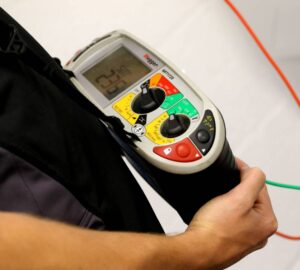
Using specialist test equipment, the inspector checks continuity of protective conductors, insulation resistance, polarity, earth fault loop impedance, prospective fault current and RCD operation. These tests show problems you can’t see, such as cables breaking down inside walls or protective devices that wouldn’t disconnect quickly enough in a fault.
3. Recording the results
Every circuit’s results are recorded in a schedule of test results, alongside a schedule of inspections and details of the supply, earthing arrangements and boards.
4. Issuing the report
The finished EICR lists any observations with their codes, gives an overall outcome and recommends when the next inspection should take place. Any immediate dangers (C1s) should be made safe before the inspector leaves.
How to read your EICR
EICRs can run to many pages, but four parts matter most:
- The summary and overall assessment: satisfactory or unsatisfactory. This is what landlords, agents and insurers look at first.
- The observations: the list of issues found, each with a code and a location.
- Extent and limitations: what was and wasn’t inspected. Check this carefully. A report that excludes large parts of a building isn’t giving you the full picture.
- Next inspection date: when the inspector recommends the installation is tested again.
EICR codes explained
- C1, danger present: immediate risk of injury. Makes the report unsatisfactory.
- C2, potentially dangerous: urgent remedial action required. Makes the report unsatisfactory.
- C3, improvement recommended: doesn’t meet current standards but isn’t dangerous. Doesn’t affect the outcome.
- FI, further investigation required: couldn’t be confirmed during the test. Since Amendment 4, this no longer makes a report unsatisfactory on its own.
For the full detail, read EICR codes C1, C2, C3 and FI explained and what Amendment 4 means for your EICR.
My EICR is unsatisfactory. What now?
Get the C1s and C2s fixed by a competent electrician, ideally with a quote that references each observation number so you can see exactly what you’re paying for. Ask for a certificate covering the remedial work and keep it with the original report. Together, they show the installation is now safe. It’s also worth getting any FIs investigated. Our guide on what to do if your EICR is unsatisfactory walks through it.
How long is an EICR valid for?
An EICR doesn’t technically expire, but it recommends a date for the next inspection, typically five years for commercial premises and rented homes, three years for industrial sites and ten years for owner-occupied homes. The inspector can set a shorter interval if the condition of the installation warrants it.
How long does an EICR take, and how much does it cost?
A typical home takes around three to four hours. Commercial buildings range from half a day to several days, depending on the number of circuits. Cost is driven by the same factors: circuits and boards, access, out-of-hours working and the state of your records. See how long an EICR takes and what affects the cost of an EICR.
Who can carry out an EICR?
Only a competent, qualified electrician should carry out an EICR. Look for a contractor registered with a scheme such as NICEIC or NAPIT, with testers who hold an inspection and testing qualification. Be wary of very cheap “certificate only” offers. A proper EICR takes time, and a rushed one can either miss real dangers or overstate problems to sell remedial work.
Frequently asked questions
Is an EICR the same as a landlord gas safety certificate?
No. Gas safety checks are annual and cover gas appliances. An EICR covers the electrical installation and is needed at least every five years for rented properties.
Does an EICR include appliances?
No. Plug-in appliances are covered by PAT testing, although landlords should make sure any appliances they provide are safe.
Will I lose power during the inspection?
Yes, in short bursts. Circuits are switched off one at a time for testing, so you’ll usually only be without power in one area for a few minutes.
Can I use a different electrician for the remedial work?
Yes. You’re free to get quotes from other contractors for any remedial work.
Book an EICR with Martin Cook Electrical Services
We’ve carried out EICRs since 1998 for landlords, schools, offices, warehouses and data centres across London, Bedfordshire, Buckinghamshire and Hertfordshire. Every observation is explained in plain English, and remedial work is quoted separately, with C2s and FIs itemised. Request a free quote or call us on 01525 582582.
EICRs across our area
We carry out EICRs and landlord electrical safety certificates across London, Bedfordshire, Buckinghamshire and Hertfordshire, including: EICR Milton Keynes · EICR Leighton Buzzard · EICR Luton · EICR Bedford · EICR Aylesbury · EICR Watford · EICR St Albans · EICR Hemel Hempstead · EICR High Wycombe · EICR Northampton · EICR Berkhamsted · EICR Buckingham · EICR Wendover · EICR Woburn · EICR London · EICR Central London · EICR North London.
About the author: Kenny Cook EngTech TMIET has 15 years in the electrical trade and looks after sales and projects at Martin Cook Electrical Services. Got a question about your building’s electrics? Email kenny@martincookelectrical.co.uk.