By Kenny Cook EngTech TMIET
If your site has power factor correction (PFC) equipment, it was almost certainly installed to save you money. But PFC units don’t look after themselves. Capacitors wear out, contactors fail and controllers drift, and a unit that’s quietly stopped working can cost you hundreds or thousands of pounds a year in charges you thought you’d got rid of. A failing capacitor can also overheat and become a fire risk. This guide explains how PFC works, why it needs servicing, what a proper service includes, the warning signs to look out for and how often it should be done.
What is power factor, and why does it cost you money?
Power factor is a measure of how efficiently your site uses the electricity it draws. Motors, compressors, transformers, pumps and older lighting all need reactive power to create magnetic fields. Reactive power doesn’t do any useful work, but it still has to be supplied through the network, so your site draws more current than it really needs.
Power factor is the ratio between the useful power you use (kW) and the total power drawn (kVA). A power factor of 1.0 is perfect. Many industrial and commercial sites without correction run at 0.7 to 0.85.
Reactive power charges
On half-hourly metered supplies, network operators charge for excess reactive power. In practice, if your site’s reactive energy (kVArh) exceeds roughly a third of its active energy (kWh) in a half-hour period, which equates to a power factor below about 0.95, you pay a reactive power charge. These charges appear on your electricity bill, often as a line many people don’t notice.
Capacity charges and losses
A poor power factor also means a higher kVA demand, which can push up capacity or availability charges and limit how much more load your supply can take. Higher current means more heat and losses in your cables, switchgear and transformers too.
How power factor correction works
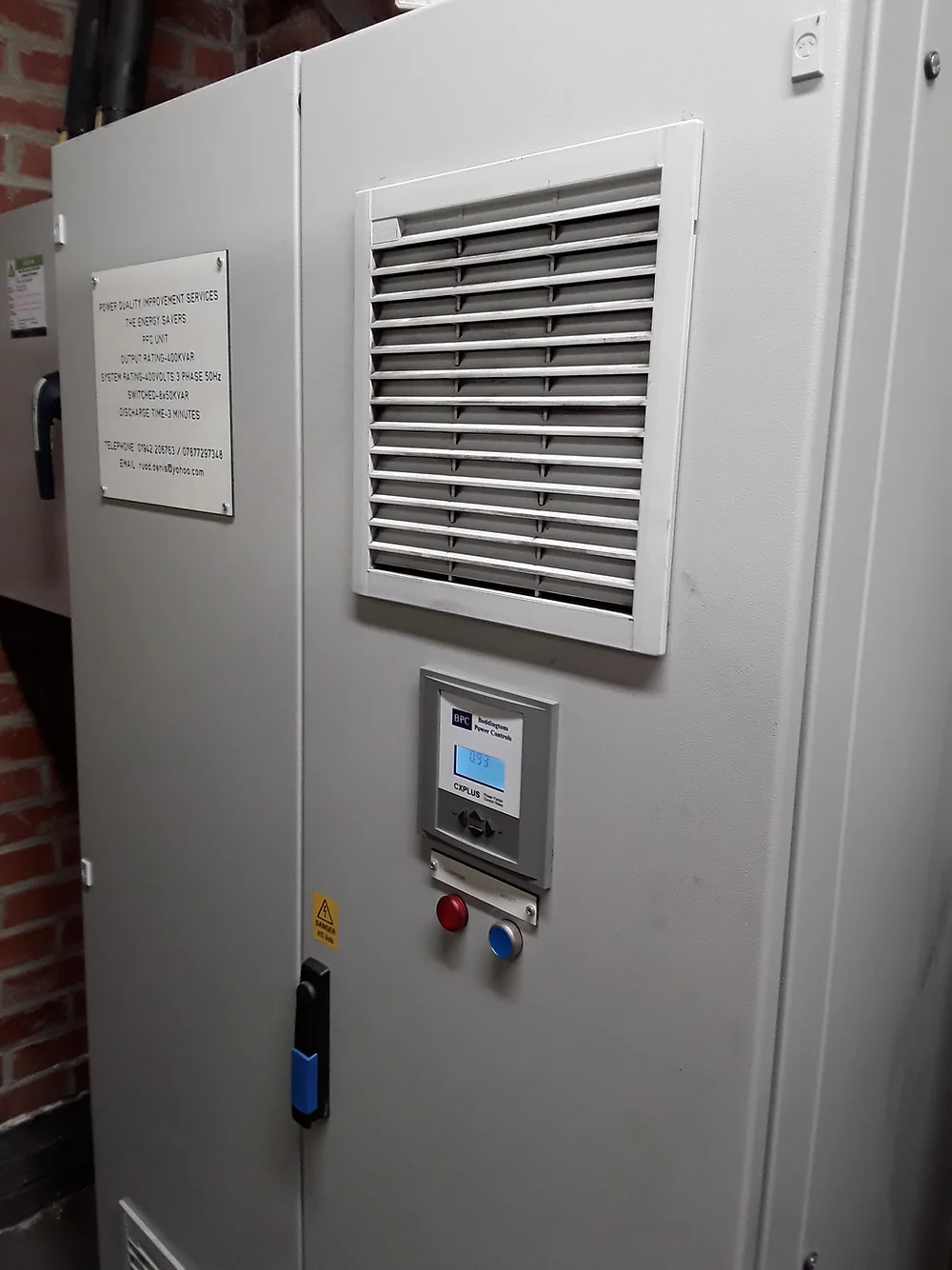
A PFC unit is a cabinet of capacitors connected to your main switchboard. The capacitors supply the reactive power your equipment needs locally, so it doesn’t have to be drawn from the network. A controller (also called a regulator) measures the site’s power factor and switches banks of capacitors, called steps, in and out through contactors to keep it close to the target, usually around 0.95 to 0.98.
On sites with lots of variable speed drives, LED lighting, IT equipment or other electronic loads, harmonics can interact badly with plain capacitors. Those sites usually need detuned PFC, where reactors are fitted in series with the capacitors to protect them. We explain more in understanding PFC capacitors.
Why PFC equipment needs regular maintenance
Capacitors lose capacitance over time
Heat, voltage stress and harmonics gradually degrade capacitors, and their capacitance drops. As it falls, each step corrects less than it should, until the unit can no longer hold your power factor above the charging threshold. Because it happens slowly, it often goes unnoticed until the reactive charges reappear.
Contactors and fuses fail
Step contactors switch in and out many times a day and their contacts wear. Fuses blow and aren’t replaced. Either way, a step stops working and the unit loses part of its capacity without any obvious sign.
Controllers drift or get set up wrongly
Incorrect controller settings, a failed current transformer connection or a change in site load can leave the unit under-correcting, over-correcting (leading power factor) or hunting, switching steps in and out constantly.
Overheating is a safety risk
PFC cabinets generate heat and rely on fans and filters to stay cool. Blocked filters or failed fans shorten capacitor life dramatically, and a capacitor that fails badly can swell, leak or vent, creating a genuine fire risk inside your switchroom.
What a proper PFC service includes
A thorough service should cover all of the following and be written up in a report you can actually use:
- Safe isolation of the unit and checks that capacitors have discharged
- Visual inspection for swollen, leaking or damaged capacitors, overheating, burnt connections and contamination
- Capacitance testing of every capacitor and every step against its rating
- Inspection and testing of step contactors, including pre-charge and damping resistors
- Checks on fuses, discharge resistors, terminations and torque
- Checks on detuning reactors for overheating, where fitted
- Controller checks: target power factor, settings, alarms, step sequencing and the current transformer connection
- Cleaning and checking cooling fans, filters and thermostats
- A thermal imaging scan of the unit under load
- Measurement of the site’s power factor and, where relevant, harmonic levels
- A report showing the condition of each step, the power factor achieved and any parts needing replacement, priced separately
Signs your PFC unit needs attention
- Reactive power charges reappearing on your electricity bill
- Alarms or error codes on the controller display
- Steps that never switch in, or switch in and out constantly
- Blown fuses or tripped protective devices in the cabinet
- Buzzing, crackling or a burning smell
- A hot cabinet, failed fans or blocked filters
- Bulging, leaking or discoloured capacitors
- No service record, or none in the last year
If you spot bulging or leaking capacitors or a burning smell, keep people away from the cabinet and get it checked urgently.
How often should PFC be serviced?
Most manufacturers and specialists recommend a service at least once a year. Sites with heavy or variable loads, high ambient temperatures or significant harmonics may need checks every six months. It’s also worth checking your electricity bill every month for reactive power charges, which are often the first sign a unit has stopped doing its job.
Repair, refurbish or replace?
Many PFC units can be brought back to full performance by replacing failed capacitors, contactors and fuses. If the unit is very old, uses obsolete parts, or your site’s load has changed, for example with lots of new drives or LED lighting, a resized or detuned replacement may be better value. A power data logging survey will show exactly what your site needs before you spend anything.
How much does PFC maintenance cost?
It depends on the size of the unit, the number of steps and how much needs replacing. A routine service is usually a small fraction of the reactive power charges a failed unit can rack up in a year, which is why most sites see it as one of the easiest maintenance costs to justify.
PFC maintenance alongside your other electrical maintenance
PFC usually lives in the same switchroom as your main LV switchboard, so it makes sense to service it alongside planned switchgear maintenance and an annual thermal imaging survey. One visit, one set of paperwork, less disruption.
Frequently asked questions
Do we need to switch the site off for a PFC service?
No. The PFC unit itself is isolated during the service, but the rest of your site stays on. You may see a small change in power factor while it’s out of service.
Can you service any make of PFC unit?
Yes. We service all common makes and models, and can source replacement capacitors, contactors and controllers.
How do I know if I’m paying reactive power charges?
Look for lines on your electricity bill mentioning reactive power, kVArh or excess reactive charges. If you’re not sure, send us a recent bill and we’ll take a look.
Book a PFC service
Martin Cook Electrical Services services, repairs and upgrades power factor correction equipment for warehouses, factories, offices, schools and data centres across London and the South East, including Milton Keynes, Luton, Bedford, Northampton, London, Watford, Aylesbury, Leighton Buzzard. Request a free quote or call us on 01525 582582, and send a photo of your unit’s nameplate and a recent electricity bill if you have them.
About the author: Kenny Cook EngTech TMIET has 15 years in the electrical trade and looks after sales and projects at Martin Cook Electrical Services. Got a question about your building’s electrics? Email kenny@martincookelectrical.co.uk.