By Kenny Cook EngTech TMIET
Most electrical failures and electrical fires don’t happen without warning. A loose connection, an overloaded cable or a failing breaker gets hot first, often for weeks or months before it fails. An electrical thermal imaging survey finds that heat while everything is running, so problems can be fixed on your terms instead of during a breakdown. This guide explains what a thermographic survey is, what it finds, how it’s carried out, what your report should include and how often you need one.
What is electrical thermal imaging?
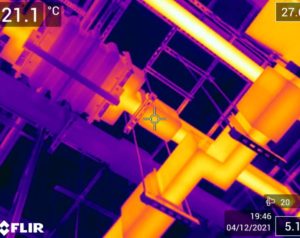
Electrical thermal imaging, also called an electrical thermographic survey or infrared survey, uses a specialist thermal camera to measure and photograph the surface temperature of electrical equipment while it’s working. Healthy components run at predictable temperatures. Faulty ones run hotter. The camera makes that difference visible, and a qualified thermographer interprets what it means and how urgently it needs fixing.
What does a thermal survey find?
- Loose or poorly made terminations and busbar connections
- Overloaded circuits and cables
- Unbalanced loads across phases
- Failing breakers, fuses, contactors and isolators
- Deteriorating power factor correction capacitors
- Overheating in UPS systems, PDUs and drives
- Cooling problems such as blocked filters or failed fans in panels
Many of these faults are invisible to the naked eye and won’t show up in day-to-day operation until something trips, fails or catches fire.
Why have a thermal imaging survey?
Prevent fires and failures
Heat at a connection gets worse over time as the joint oxidises and its resistance rises. Catching it early turns a potential fire or shutdown into a simple, planned repair.
No downtime
Unlike most electrical testing, a thermal survey is carried out with everything switched on and running normally. Nothing needs isolating, so your business carries on as usual.
Insurance
Many commercial insurers now expect, or require, a regular thermographic survey of the main electrical distribution, particularly for warehouses, manufacturing, data centres and large commercial buildings. A clear, prioritised report helps show you’re managing the risk.
Planned maintenance that’s actually targeted
Rather than pulling every board apart on a schedule, thermal imaging tells you exactly where attention is needed. It’s ideal alongside planned LV switchgear maintenance.
What equipment is surveyed?
- Main LV switchboards and busbar chambers
- Distribution boards and sub-mains
- Motor control centres and drives
- Power factor correction units
- UPS systems, PDUs and data centre power distribution
- Plant, including chillers, air handling units and compressors
- Transformers’ LV connections, where safe to access
How a thermal imaging survey works
1. Planning and access
We agree which equipment is in scope, when it will be under its normal load, and how panels will be accessed safely. Thermal imaging is most meaningful when equipment is carrying a reasonable proportion of its normal load, so surveys are timed for busy periods rather than quiet ones.
2. Safe opening of equipment
For an accurate reading, the thermographer usually needs a line of sight to the live components. That means panel covers being removed under a strict safe system of work, by competent and suitably protected engineers, or using infrared inspection windows where they’ve been fitted. This is one reason thermal surveys should only be carried out by people who are both qualified thermographers and experienced electrical engineers.
3. Scanning and measurement
Each item is scanned, with thermal and standard photographs taken of anything abnormal. The thermographer records the temperature of the hot spot, a comparison point such as the same component on another phase, the load at the time and the ambient temperature.
4. Analysis and report
Findings are assessed by how much hotter the problem is than it should be, then ranked by severity so you know what needs urgent action and what can be planned in.
What should your thermal imaging report include?
- A summary of findings, prioritised by severity
- A thermal image and standard photograph of each issue
- The location, equipment and component affected
- Measured temperatures, the temperature difference and the load at the time of survey
- A clear recommendation for each finding
- A list of everything surveyed with no issues found, so you know it was checked
- The thermographer’s name and qualification
A report that only lists problems, without showing what was surveyed, makes it hard to prove coverage to an insurer.
How often should you have a thermal survey?
Annually is the most common interval for commercial and industrial sites, and it’s what many insurers ask for. Critical environments such as data centres and hospitals often survey more frequently, and anything found on one survey should be re-scanned after repair to confirm the problem is gone.
Thermal imaging vs fixed wire testing
They’re complementary, not alternatives. A fixed wire test (EICR) checks that the whole installation is safe and compliant, but requires circuits to be switched off and only happens every few years. Thermal imaging checks the main distribution under real load, with no downtime, and is typically done every year. Together they give you a far better picture than either one alone.
What thermal imaging can’t do
A thermal camera only sees surface temperatures at the moment of the survey. It can’t see inside cables buried in walls, it won’t find faults on circuits that aren’t loaded at the time, and it doesn’t test whether protective devices will operate correctly. That’s why it complements an EICR rather than replacing one.
Who should carry out the survey?
Look for a thermographer qualified to at least ITC Level 1 (Category 1), working for a company with real electrical experience, so the findings are interpreted correctly and the panels are opened safely. A good surveyor will also be able to quote for and carry out the repairs, then re-scan to prove they’ve worked.
Frequently asked questions
Do we need to switch anything off?
No. The survey is carried out live and under normal load. Some panels may need covers removed safely, but power stays on throughout.
How long does a survey take?
A small site with a main board and a handful of distribution boards might take a couple of hours. Larger sites and data centres can take a day or more.
Will the report satisfy our insurer?
A properly prioritised report from a qualified thermographer, showing everything surveyed, is what most insurers are looking for. If your insurer has specific requirements, send them over and we’ll make sure the report meets them.
Book a thermal imaging survey
Martin Cook Electrical Services carries out electrical thermal imaging surveys with ITC Category 1 qualified thermographers, for offices, schools, warehouses, manufacturing sites and live data centres across London and the South East. We can repair what we find and re-scan to confirm it’s fixed. Find out more about our thermal imaging services, request a free quote or call us on 01525 582582.
About the author: Kenny Cook EngTech TMIET has 15 years in the electrical trade and looks after sales and projects at Martin Cook Electrical Services. Got a question about your building’s electrics? Email kenny@martincookelectrical.co.uk.